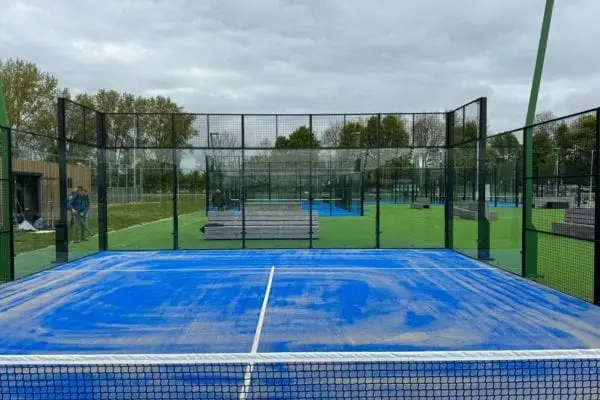
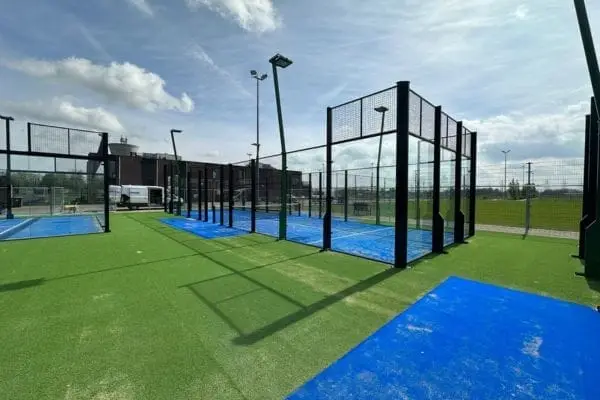
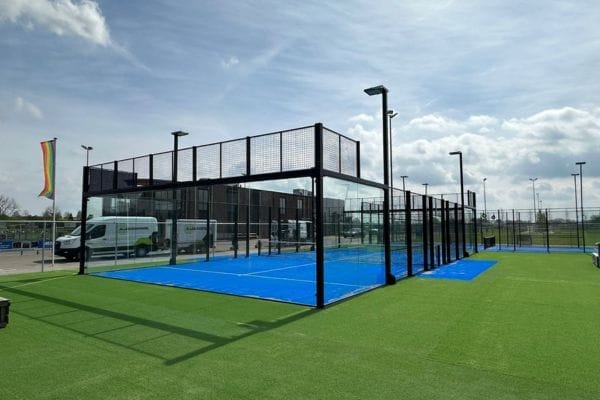
A football pitch is by far the largest sports field in a typical sports park. And that is precisely where untapped potential lies for many football clubs, local authorities and operators. Secondary pitches used only on Wednesday evenings, a second training pitch that lies empty following a decline in membership, or a corner that is consistently left unused – these are all square metres that generate no income. By converting that space into padel courts, you transform dead capital into a vibrant, profitable facility. The area of a single full-size football pitch can accommodate up to 24 padel courts. But you don’t need to go that far: often, a quarter or half of a pitch is enough for six well-occupied padel courts. The core football operations remain fully intact, and on top of that you can build a second source of income that runs all year round.
A football pitch offers something that many other sports venues do not: space. Sufficient distance from local residents, an existing infrastructure with car parks, changing rooms and a clubhouse, and often a planning permission status that already allows for sport. That makes the move to padel smaller than you might think. What’s more, it closes padel a cultural asset to the world of football, It’s sociable, competitive and fits perfectly with the “third half” mentality that every football club thrives on.
This is how we turn your football pitch into a vibrant padel facilities.
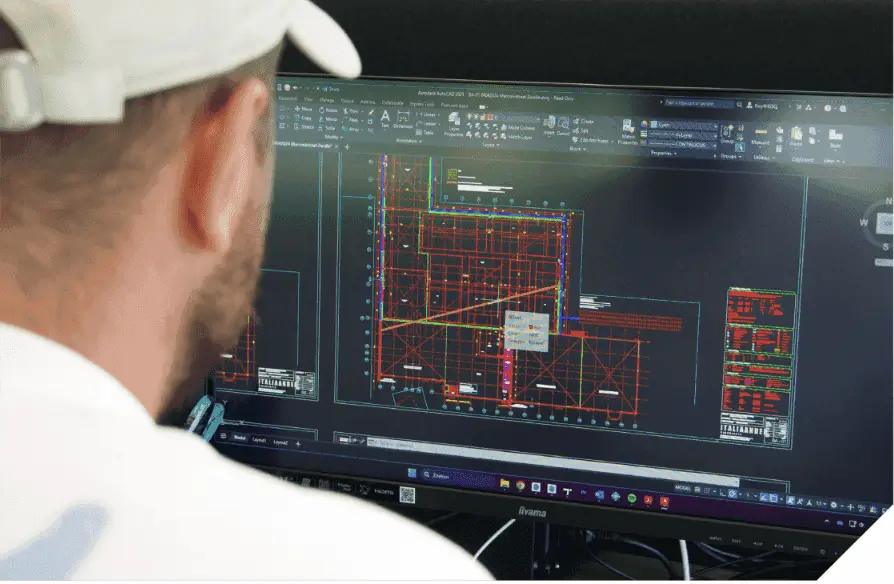
We’ll take a look at the whole sports ground and decide which part of the football pitch is best suited for padel. We work out how many pitches will fit, in what layout, and how the rest of the site can continue to function optimally.
We are building the padel courts Fully equipped with: sports flooring, cage, glass walls, fencing, lighting and artificial turf. The pitches are inspected and handed over ready for play.
Converting a football pitch into a padel court is an exciting project, but one with many moving parts. Permits, the local council, local residents, members, foundations, planning – there’s a lot involved. That’s why we take care of the entire process for you. Allesvoorpadel supports football clubs, local authorities and operators from the initial exploratory meeting right through to well beyond completion.
We develop the design, handle the planning permission process – including acoustic assessments – and construct the complete padel courts with all the necessary facilities. After completion, we remain involved through our maintenance service, ensuring the courts continue to perform at the highest standard for many years to come. One point of contact, one plan, one result.
Smart use of space, a cost-effective sports complex, a more vibrant sense of community.
A padel court A football sports complex works best when it integrates seamlessly with the existing facilities. We not only take care of the pitches, but also the Padel Flexhall for maximum annual occupancy with noise reduction of up to 30 dB, a padel kiosk for reception and lettings roles, padel maintenance machinery for day-to-day management, and the complete fitting-out of the padel court and mWith a maintenance contract, we’ll keep your pitches in top condition for years to come.
Many football clubs are facing the same reality: membership numbers are fluctuating, young people are opting for other sports, and running a large sports ground is becoming more expensive every year. At the same time, padel is booming everywhere, and padel players across the Netherlands are looking for places to play. The solution is obvious: use an unused pitch to attract a new target group, boost footfall in your canteen, and your club will end up in a healthier financial position. Football clubs that take this step often report the same benefits: dozens to hundreds of new members thanks to padel, a busier clubhouse every day of the week, sponsors coming back on board, and a sports ground that’s in use from morning till night. And best of all: the core football programme remains fully intact; padel is added on top, not in place of it. What’s more, your club will end up in a healthier financial position.
Theoretically, the area of a single full-size football pitch could accommodate as many as 24 padel courts. In practice, clubs and local authorities often opt for two to six pitches on part of the main pitch or an unused side pitch, so that the football capacity remains fully intact.
That depends very much on the number of lanes, the condition of the ground and your requirements regarding lighting and any roofing. We’d be happy to provide a bespoke quote so that you have a realistic idea of what to expect for your specific project.
No, in most cases only part of the pitch is used, or a secondary pitch that is structurally under-utilised. This means that the main football pitches remain fully available.
Sometimes yes, but not always. It depends on the type of subsoil, the state of the foundation and the soil conditions. During the site analysis, our specialists assess whether the existing pavement is suitable as a basis for a padel court, or whether additional groundwork is needed.
For almost every padel court An environmental permit is required for a sports complex. The local authority assesses compliance with the local plan, as well as noise and traffic levels. Allesvoorpadel provides support throughout the entire planning permission process.
Wir sehen, dass Sie diese Website aus Deutschland besuchen.
Für die deutsche Version klicken Sie bitte auf den untenstehenden Button.